Preparing the way is the Way

The current image has no alternative text. The file name is: image-1.jpeg


Almost Christmas. I get gifts, especially for the grandboys, put up a tree and a few decorations, send out some cards. There will be a holiday meal, either Christmas Eve or Day. Basically I don’t go as “Christmas crazy” as I used to. That was probably overcompensation on my part. After all those years of unrecognized seasonal depression. I felt like Ebenezer Scrooge, cranky and cynical. I thought that it was all phony–goodwill to men covering up personal and corporate greed. The former stoked by the latter. So I tried to cover up that cynicism. 

I still think Christmas is overdone. But one thing that comes up for me this time of year is the season of Advent. Now Easter seems all about suddenness–Jesus’ march through the city, betrayal, death, and resurrection, all in a matter of days. Christmas, on the other hand, we’re told was long expected.  There was prophecy and preparation for the coming of a messiah. Advent–a week’s long preparation for the Messiah’s coming– was a later addition by the church. In many ways it has become the core in some ways of this season, sure as the fact the sun will stop its northward drift. The days will start to lengthen, and the world again befilled with Light. Whether to kids with their Advent calendars, or adults counting the days down to Christmas.

Advent is interesting to this former comparative religions student, even if I wasn’t a formal one. It is mostly my Christian training and upbringing, then compared against Buddhist teachings as I began to practice Zen. And here’s where I’ll reveal how little I really know about these teachings, especially Christian. But mалу, even most religions, have this belief, this prophecy, of someone or something coming to this fallen world. Not just of a heaven beyond this life, but that this very world will, if not transform, be redeemed. Christ, the future Buddha Maitreya, and others will come. 

The teaching of Christians (and also to Jews as I understand it) is that we must prepare the way for the coming of Christ, the Messiah. People must become ready, and make themselves and the world be in accord with what the world will become at that time. It’s in the secular Christmas themes too, the canon of stories like A Christmas Carol, of an individual or entire world lost, and found, then filled with light. The Zennist in me wants to say that it’s really just finding the light already there in this world. 

But in this season we prepare our homes and our souls–fill our homes with colors, light, the scent of sweets, and the feasts. As to ourselves, we find and cultivate the joy and kindness within everyone so we become ready as the world does, to have this love, this redemption, clarity and peace, this special being enter into it. We perform acts of joy: of gathering together, and singing, laughing, sharing what we have with others. Giving gifts to friends and family, and especially to those we may not even know, who are in need of light, gifts, of the very basic necessities of this life. We make of ourselves, and this world, the best version of both. But if all that wasn’t already present, how can we just manufacture it?

The tragedy, to look at the other side of it, is that we drop it, lose it, put it aside. Perhaps because we buy this idea it was forced, false, something we created. And we were not really preparing the way for Christ or Buddha. It was all playacting, temporary. Because if it were real, it would continue. We’d see it and allow it to do so. The coming of love, of light, of peace, would continue. Having found it (or as I argued, finding what was already there) we’d do our best to nurture it, to keep it alive. 

The lesson we miss is that we were the ones who found it. We brought this to life. In preparing to have this world transformed into the kingdom of God, and to bring heaven to earth, to bring awakening to this world, we have made this earth a heaven. We are the ones who have awakened, who made this very place the kingdom of heaven. It’s as though Christ’s or Buddha’s actual appearance is almost unnecessary, just an afterthought. 

We are Christ, We are Buddha. We are the ones who redeem and transform this world, by seeing it and ourselves differently and most importantly, in acting differently. These acts of giving, of kindness, love and selflessness are the way we accomplish this. Too often then, either in reality or in our minds, we just say, “Ok, I’ve done my work here. The Messiah or Maitreya are here. Now I can relax, sit back. No need to do anything more, the Messiah has got it covered.” We miss what we’ve done, what we found and created. The light of the new world fades, and we return to winter in our hearts.

If only we could continue with this work which, come on, be honest, really isn’t that much work. We only make it so through the craziness we take on when we push to make it comply with an idea we have of how things should be, rather than allowing it to naturally flower. Which is again, at root, a kind of greed.

Remember, at the end of A Christmas Carol, Scrooge says, “I will honor Christmas in my heart and try to keep it all the year.” Or as Zen teacher Hakuin said, “This very place is the Lotus Land.” Or Jesus put it in the Gospel of Thomas, “Rather, the kingdom is inside of you, and it is outside of you.”

Merry Christmas!

Zen Hair

Sitting out on the patio in the old wobbly highchair, the metal cool against my bare back.  Thinking only, “Don’t move, don’t move.”  The buzz of the clippers the only sound I hear, except when my mom repeats the same command I whisper to myself.  “Don’t move or it will be ruined.”  Six years old, and this is how I got my haircut in those days.  As hard as I tried, I always moved, when a few hairs tickled my nose, or the head on the clippers suddenly loosened and clacked wildly next to my ear.  The result of that moment’s wiggle always visible.  I don’t think I ever got out of that chair without a nick or bald spot somewhere on my head.  “It will grow out,” my mother’s soothing reminder.

This body is a car

Hui-neng, 6th Century Zen teacher, said, “The physical body is a house, but you can’t rely on it.”* And I say, the body is a car, and we all know you can’t depend on a car. 

You find that one aspect of getting older is all the ways this body starts to wear out. “Suffering is old age, sickness, and death,” according to Buddha. And even the healthiest of us can’t avoid it forever. In my more generous moments I can see it’s part of the adventure of living this life in these meat suits, as my friend David puts it. And this wearing out is mostly all the usual and ordinary problems – hair thinning, skin thinning, joints becoming less flexible.

I had an old back injury flare up a year ago after a doctor gave me antibiotics for diverticulitis, which also often is a result of aging. The antibiotic caused serious tendinitis in my Achilles tendon, so that I had difficulty walking. Talking with the physical therapist I worked with on for my recovery, he said there was some “deconditioning due to the tendinitis and lack of movement,” which exacerbated the old injury. He called it “wear and tear.” Which sounds like what your mechanic might tell you about your brakes.

Many years before that my hip was causing me lots of pain, probably due in part to that wear and tear in my back. It turned out there was a great deal of arthritis in my hip, and I finally realized I had to have it replaced with an artificial joint. Beforehand, the doctor showed me what the replacement joint looked like – it was titanium, shiny and new. And looked to me like nothing so much as a chrome car part. 

I don’t always remain under anesthetic long, so at the end of that surgery I came to while I was still on the operating table. The doctor was the only person remaining in the operating room, and I began talking with him. In my woozy state, and out of strange curiosity, I asked if I could see the head of the femur. He took some tongs, and pulled what looked like a softball out of a five gallon bucket. It was smooth as a pearl, and he pointed out how bare it was, with no cartilage left on it. Afterwards, I wondered whether he thought I was asking to see it, like a customer would with his mechanic at the garage. Wanting to see the defective part while the car was still up on the lift, in order to check the wear and tear on the brake pads, to be sure that they really did need replacing. 

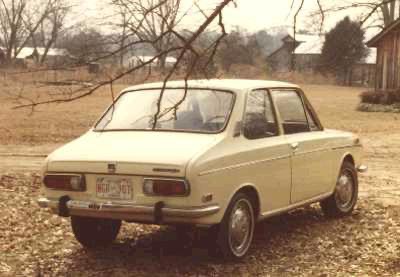
My old friend Ted, who was my roommate for a time, and a writing practice partner, was also a mechanic. He worked on my car a few times. It was an old Subaru, and he managed to keep it running a little longer each time. Finally, it broke down on a longer trip, and I had it towed back home. I asked Ted if he could look at it, and he said he would. I came home that night to find he’d left me a note on the kitchen table: For sale–1969 Subaru. No working clutch. Would be a good car to push off the High Bridge into the Mississippi River. A lesson in radical acceptance and letting go. 

Ted’s car was an old Honda Civic which, through the wonder of transferred titles and recalls, had two brand new bright yellow fenders on it to replace those that had disintegrated due to a design flaw, and were recalled. This was on a car where the whole thing was mostly rust more than anything else. He let me borrow it for a few days after my car died. Along with the keys, he handed me 3 pages of numbered instructions for driving it: 

  1. First pull the detent for the clutch knob out to the second detent. Turn the engine over. Then move the clutch to the third detent and try it again. It should start then. If it doesn’t, repeat those steps. 
  2. Don’t follow anyone one too closely, as the brakes are going out. 
  3. Try not to use the heater if you can help it. 
  4. You need to have the defrost on high to get any air to come out. 
  5. (And my favorite:) The head gasket is starting to go, so when you first start it up, there will be a big cloud of smoke, vapor, and exhaust coming out of the tailpipe. It’s nothing to worry about. My suggestion is that you just drive away immediately and as fast as you can, so no one knows it’s coming from you. Drive it for a short distance–the engine will warm up and the smoke will stop.

Some days I feel like I’m working from a similar list as I begin the day. 

  1. Don’t get out of bed and start moving too fast. 
  2. Cataracts have been removed, so vision will be good, but takes a few minutes to get clear. 
  3. The chassis is slightly bent, and will list to one side for a bit. 
  4. Alignment of the jaw is off, so you will hear a clicking sound. It’s nothing to worry about.
  5. Get the hearing aids in quickly, and that should take care of the ringing in the ears. 
  6. Yes, it does have some wear and tear, but after 69 years it is still on the road. My suggestion is that once you get it moving, take off as quickly as possible.  

As Ted might say, leave what’s behind you as quickly as you can and keep moving. A few blocks and it should run fine for the rest of the day.

*Translation by Dosho Port, Roshi

Adventures on the Way

Long-distance driving often feels like meditation. Sitting upright, remaining alert and relaxed. Watching how the road unfolds ahead, and unspools out behind me. Nowhere really to be, except exactly where my tires are, the road beneath them as I travel along. At 65 mph, right where I am so clearly does not last at all. And it’s easy to focus ahead and behind. The center line accelerating as it gets closer, a Doppler effect of white, vanishing beneath the front bumper. Easy to grow hypnotized by that, as well as the line trailing behind me. I remember as a child sitting with arms folded, head and chin resting on the rear seat back, the blur of what is right along side is just movement, and easier to see in contemplation of it as the past, People, places, memories, goodbyes are back there. What reason, really, is there for the driver to watch that?. Scanning the rearview mirror as I was taught, looking for what?— either a rapidly approaching car that will push me to the ditch, or a police car, siren going and lights flashing, moving to another emergency. Or perhaps after me, for some mistake I made, turned without a blinker on, or when they aimed their radar at me. So that place, there behind, is for worry and regret. As in life. And maybe sa few sweet memories or goodbyes. Perhaps home is always what is left behind there. Or is home  what lies ahead, the anxiety of returning, for helloes and embraces of those I love? Or to a new home, greetings to those I’ve never met, worry there about what’s to come, mixed with excitement of what is to be. The only thing real is what is right beneath me.—taking care not to become too hypnotized by the road trailing behind, leaving no tracks on the smooth asphalt; or the road lying ahead.

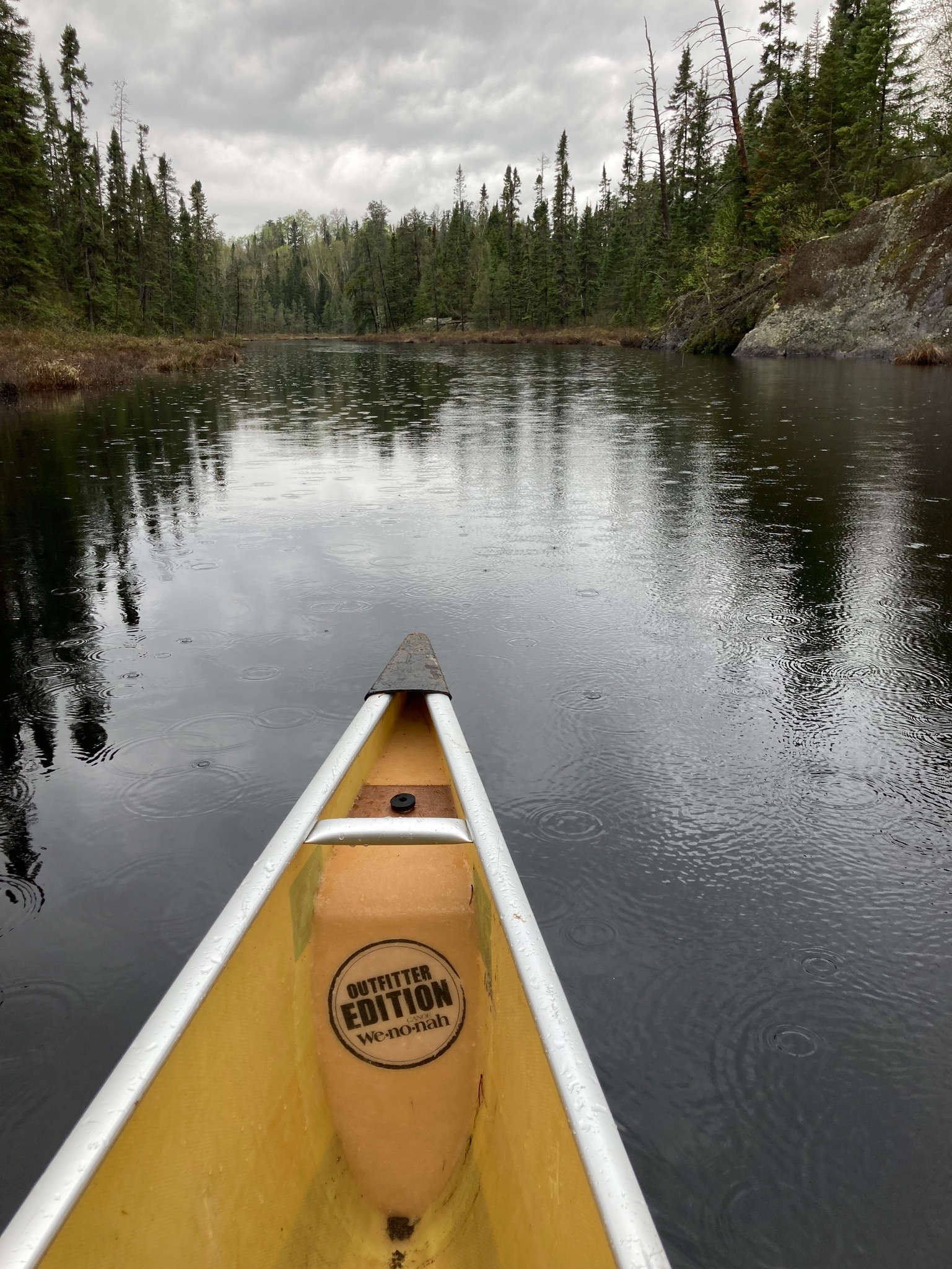
Today, my friend Michael and I are in the car, heading to the Boundary Waters Canoe Area to reenact a trip made as young men 49 years ago. On that first trip we were dropped off in the Canadian wilderness by train and paddled for a week, Michael, Rick, and I. Worries then about girlfriends left behind, missing them and perhaps more, missing the music we lived to hear each day, the friends, and beer. Worried about the road ahead, the border, where we’d hide our supply of pot for a week’s traveling in these lakes and streams. Today, old men, we carry no drugs, except the Advil metered out to last us for the 7 days of this trip. Heading up the interstate, then 30 miles down a dirt road to the outfitters and on into the wilderness, muddied by rains over the last month. Heavy rains as we drive today, following us all the way for 300 miles. Hopefully there will be a break once we set out from the outfitters with our canoe, equipment and food.

And then, days of paddling. Michael more comfortable and skilled at being in the stern and steering. My job to just paddle in the bow. My excitement to be here translates into continually increasing my pace, and Micheal me again to slow down. Then it occurs to me to tie the stroke to breath. I begin the stroke, paddle entering the water, with my out breath, when strength is greatest. After completing the stroke, I lift it out of the water and bring the paddle back to the front of the canoe, breathing in, a deep breath to begin again, and with the beginning of the out breath I pull the paddle along again. It works, and I am able to maintain a steady rhythm, even when the wind or rain comes, waves rise up, and it becomes more work. And my meditation practice is useful here too, not just tying into the breath, but remaining balanced and upright, head clear as thoughts flow by like the waves around us. Older now, as I say, we pace ourselves, not harsh and urgent paddling or hiking on portages. We’ve planned one hard day, and then we’ll rest at a campsite for as long as we want. Take side trips, and return to the outfitter’s with a leisurely day or two of paddling. 

Second to the last day, It’s raining, windy, so we decide to make it a two-day trip back. Refreshed and rested from a 3 day layover, we’re ready for the hard paddling and portages through mud and over the Laurentian divide. Here too, best to just focus on what’s beneath my feet. Looking too far ahead at the rising trail, or the downhill slog on the other side, steals me away from this moment—this decision about where to set my foot, to avoid water, mud, a stumble or a broken ankle. What is behind or ahead is of no matter, all is funneled into this moment and this step on the trail. Rains have left the trail even muddier than on the way in, and so I am more careful about not ending up with my foot in mud up to my knee, nearly unable to get it out. 

A day of this, and we’re only about two hours straight down Sawbill lake from the outfitters and the end of this journey. We camp one more night, then set out mid-morning, feeling there’s no rush since we don’t have to be in until 4:00. Break camp, divide up what goes back to the outfitters and what we’ll keep. We set off in light winds and slight drizzle. Halfway down the lake the winds pick up, rain increases. The canoe is low in the water, waves go from a foot high to 2 feet high, maybe more. We make sure to stay away from the center of the lake, where even if with life vests and a canoe to hang on to if we tipped, it’s not certain we’d last long enough in the cold water to make it. So we hew to the shore, looking for spots to safely put ashore if we need to. 

At times, between the wind and waves, I paddle as hard as I can just to stay in one place, but not with the ease of a bird riding the wind. It’s hard work, and scary. Still timing paddling to breath, easy to do more quickly now since breath comes faster with exertion and worry. We’re just about to go round a point and hope we’ll see the end, the dock for the outfitters down the lake. Before we can reach it, trying to remain upright, calm, strong only in the moment right there, not looking at the past, or too hungry to reach the end, putting all into remaining afloat and safe right here. And suddenly, a turn that is nearly imperceptible, just enough that we’re no longer to headed directly into the wind and waves (and which Michael would blame himself for after, wrongly I’d add.) It’s just enough to catch the bow. That moment I’ve been dancing with, between what has passed behind, and what lies ahead, is suddenly cleaved like the 15 foot basalt boulder we passed earlier, cleanly split down the middle. There is no past or future, only the smooth hard surfaces of this moment I am thrust into, literally, as the water opens up and takes me in under its surface. I am freshly awakened bye the cold water, and find as I come up that I’m under the canoe. Again, no past or future, just this moment, as I go down again to try to come up around the canoe. And I do come up, already too far away to get back to the canoe, upside down now, and see Micheal hanging on to the canoe. He calls to me, as he couldn’t see me when I was under, which he hadn’t done. “I’m ok. You just swim to shore!” he shouts. So I do, covering the 30 yards or so to the rocky shore. We make it to dry land and find all our gear, including sleeping bags, are soaked. No way we’re putting back in with the chop that’s out there. We get to a clearing, out of our wet clothes, and put on what little we can find that’s still dry. Frightened, shivering, unsure of what to do next. But with the question of what is this present moment suddenly answered for once and for all in my heart and mind.

So…we waited out the storm and wind and made it safely back that evening with one last wild paddle. The next day I drove home, dropping Michael off on the way for a ride to Chicago and a reunion of college friends. Back home in the following days, that moment of capsizing was still like one of the giant boulders submerged in a stream, not moving, in my path every way I turned. I thought about it all, with second-guesses and recriminations, all the human ways of dealing with something like that. Had we been fools, should we have done something differently, were we really in the danger I felt we were? I remained drenched with the feeling of life’s uncertainty. It was a story to tell, an exciting one even, but I found I downplayed the danger. And realized in doing so I also minimized the fear I’d felt, and the wonder of the experience. How there’d been no room for thoughts, just the cold water, the immediacy of the moment, the need to find the surface and air. There was time right afterwards for thinking—formulating a plan, assigning blame, questioning ourselves, deciding whether to stay there and camp or try to get to the outfitters, worrying about hypothermia, as Michael had been in the water longer than I had and couldn’t seem to get warm.

But in reflection I returned again and again to the moment of seeing past and future, him and me, life and death, break like that stone and only the urgency of life remain in its center. Only response, action and awareness of the closeness always of death, and feeling that even when death comes it will simply be another step on this path. To be faced with…not urgency, not calm, but something beyond thought. Just meeting whatever is presented and what the moment required.

The night we were to come off the trail we’d made arrangements to stay at a cabin on Lake Superior, in a small resort that had not yet opened for the season. It had a woodturning sauna five feet from the lake, and after a week of mud, cold water and no showers we were looking forward to it. We arrived late, but the owners still fired up the sauna for us, and we headed down with great anticipation to use it. Opening the door, the entire sauna was filled with smoke. “Is it supposed to be like this?” Michael asked with alarm. No it was not, and we told the owner. Then we proceeded to bring her buckets of water as she put out the fire that had started in the wall next to the stove. A final reminder for the day from the universe, that life is uncertain and an emergency case moment to moment. There was to be no sauna that night. Just hot showers, and warm dry beds. 

Lying there, settling into the blankets and thinking of the day’s adventure, I remembered something Katagiri Roshi had said years before in a talk. “We all want awakening to be something spectacular, with thunder, lightning and great excitement. But enlightenment is simpler, more like traveling all day on the road, and at the end of the day’s journey coming to a quiet clean motel room to rest in.” That was more than enough for me at the end of this day.